Sport for office workers, or how to incorporate sport into your work schedule
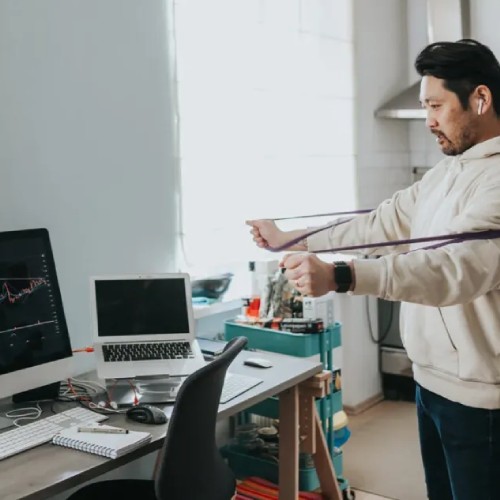 The modern working day often lasts 8–10 hours and is accompanied by low mobility. At the same time, adults are recommended to engage in 150–300 minutes of moderate physical activity per week and at least two strength training sessions to maintain good health. This does not require two hours of exercise every day. The goal is to distribute the load so that it becomes part of your schedule, not a separate project.
The first principle is planning. Training should be on your calendar just like a work meeting. The optimal format for busy people is 30–40 minutes 3–4 times a week. This can be two strength training sessions and one or two cardio sessions. If time is limited, short 20-minute sessions with basic exercises such as squats, push-ups, pull-ups and planks are suitable. Regularity is more important than duration.
The second principle is to use ‘windows’ throughout the day. Morning workouts reduce the risk of skipping exercise due to a busy evening. If you start work early, you can move your activity to your lunch break: a brisk 20-30 minute walk covers a significant portion of your daily exercise requirement. In the evening, short strength training sessions at home without equipment are suitable.
The third element is everyday activity outside the gym. Climbing stairs, 8–10 thousand steps a day, and short warm-ups every 60–90 minutes reduce the negative effects of prolonged sitting. Even 5 minutes of movement every hour improves blood circulation and reduces strain on the lower back and neck.
For office work, a micro-break routine is useful: 2–3 sets of 10–15 squats, light chest stretches, shoulder exercises. This takes less than 5 minutes and does not require any special equipment. When working remotely, you can add short full-body routines between tasks.
If your schedule is unstable, follow the principle of a ‘minimum mandatory programme’: two strength training sessions per week as a basis. Cardio can be added through walking and everyday activities. This approach allows you to maintain muscle mass and control your weight even when you are very busy.
Logistics are also important. Home workouts save time on travel. If you choose a gym, it is worth choosing a location close to work or home. Being in good shape and having a plan in advance reduces the likelihood of skipping workouts.
Sleep and recovery directly affect your resistance to stress. When you are stressed at work, it is better to reduce the intensity but maintain regularity. 7–9 hours of sleep maintain hormonal balance and reduce the risk of fatigue.
Integrating sport into your work schedule is not about finding free time, but about reallocating priorities. 3–4 hours a week, evenly distributed throughout the week, allow you to stay in shape without compromising your professional activities.